



Mfsd2a is the primary transporter for DHA across the BBB. It selectively carries LPC-bound DHA—not unesterified DHA—into the brain. When Mfsd2a function is impaired in animal models, brain DHA drops significantly even with adequate dietary intake. In humans, loss-of-function mutations cause microcephaly syndromes with intellectual disability. Transport mechanism matters more than dose size.


Sold out
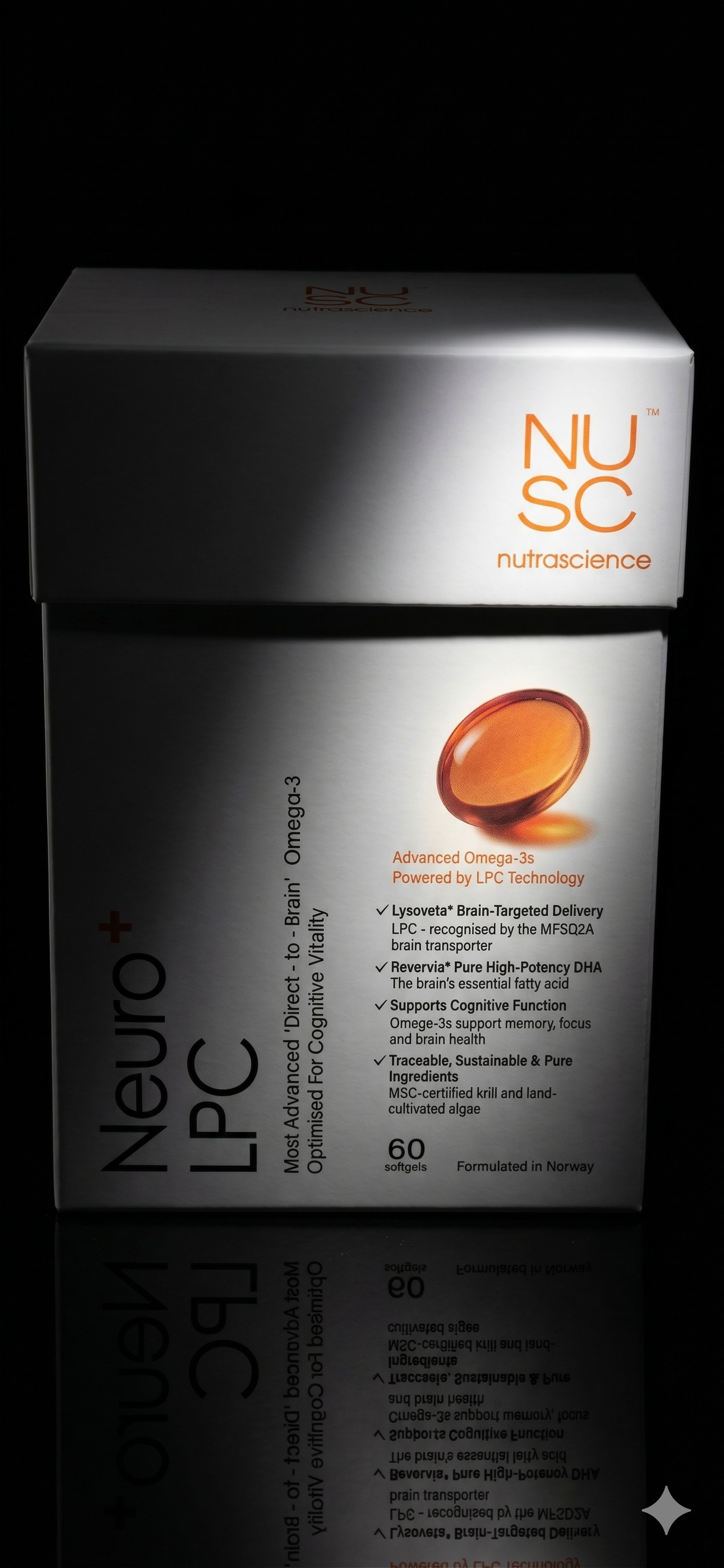
Neuro+ LPC Targeted DHA Delivery System™
Brain - Eye Targeted DHA.
Systemic Omega-3.
One Protocol.
Your brain and eyes need more DHA than any other tissue.
Most supplements never reach them.
Neuro+ LPC is built around the transport pathway that does — the MFSD2A transport.
Regular price
RM205.80 MYR
Sale price
RM205.80 MYR
Regular price
Only RM6.86 MYR/day

Lysoveta® Brain + Eye Targeted

Full-disclosure formula

Clinically dosed. Not over-dosed

Third-Party Tested
Product Details
Brain - Eye Targeted DHA Delivery System.
Advanced Omega-3s Powered by LPC Technology.
Key ingredients
What You Get Per Serving (2 softgels)
- Lysoveta® Krill Phospholipid Complex - 200mg
- Revervia® Pure Algal DHA Oil - 400mg
- Total Omega-3s (EPA + DHA) - 288mg
- Total Phospholipids - 80mg
- Astaxanthin (Natural Antioxidant) - 25μg
- Other ingredients: Bovine gelatin, glycerin, purified water, mixed tocopherols (vitamin E).
How to use
Take 2 softgels daily with a meal containing fat. Best taken with breakfast for optimal absorption.
*****
The Fast-Track Protocol
Phase 1: Kick-Start (First 14 Days)
Take 4 softgels daily (2 with breakfast, 2 with lunch). This loading phase accelerates tissue saturation, shortening the "runway" to noticeable results by 50%.
Phase 2: Maintenance
Take 2 softgels daily. Always consume with a meal containing fat—ideally breakfast—to maximize bioavailability and ensure 100% absorption.
60-day satisfaction guarantee
If you're not satisfied for any reason, contact us within 60 days of purchase for a full refund.
✉️hello[@]nutrascience.co
Neuro+ LPC Targeted DHA Delivery System™
60 Softgels | 30 Days
Getting DHA into your brain + eye is harder than you think.
Your brain is selective. Its barrier only lets DHA through in one molecular form — LPC. Most omega-3s don't have it.
Your body benefits. Your brain + eye? Left waiting at the gate.
That's a transport biology problem.
The Solution
Neuro+ LPC Works On Two Tracks
Most omega-3s go everywhere. None reach where it matters most. Neuro+ LPC is build to do both.
Why two tracks?


Per 2-softgel serving
| Ingredient | Amount | What It Does |
|---|---|---|
| Lysoveta® LPC-DHA Complex | ||
| Lysoveta® LPC-DHA Complex | 200mg | Brain + eye targeted delivery |
| LPC (Lysophosphatidylcholine) | 54mg | Mfsd2a transporter substrate |
| Phosphatidylcholine (PC) | 14mg | Cell membrane support |
| Total Phospholipids | 80mg | Brain cell membranes |
| Omega-3s (EPA + DHA + DPA) | 60mg | Anti-inflammatory omega-3s |
| Revervia® Pure Algal DHA Oil | ||
| Revervia® Pure Algal DHA Oil | 400mg | Systemic omega-3 support |
| DHA (triglyceride form) | 228mg | Heart, eyes, inflammation |
| Total Active Ingredients | ||
| Total Omega-3 | 288mg | Combined daily dose |
| Total DHA | 242mg | 14mg from krill + 228mg algal |
| Total EPA | 38mg | From krill complex |
| Astaxanthin | 25μg | Natural antioxidant from krill |
| Other Ingredients | ||
| Bovine gelatin, glycerin, purified water, mixed tocopherols (vitamin E). | ||
How to Use
Take 2 softgels daily (best with a meal containing fat).
Best taken with breakfast for optimal absorption.
Who This Is For
Consider Neuro+ LPC if you:
The science behind Neuro+ LPC
Why LPC Form Matters
The blood-brain barrier (BBB) and blood-retinal barrier (BRB) are highly selective. Standard omega-3 supplements deliver DHA in triglyceride form—but these barriers preferentially accept DHA bound to lysophosphatidylcholine (LPC).

Lysoveta®
Lysoveta® is an LPC-enriched krill phospholipid complex that delivers omega-3s in this brain- and retina-recognised form. It received FDA New Dietary Ingredient Notification (NDIN) acknowledgement in 2023.

Revervia®
Revervia® delivers 228mg of pure algal DHA per serving from Schizochytrium sp. microalgae—sustainable, contaminant-free, and vegan-compatible.
What the Research Shows
Brain
Eyes
Mfsd2a is highly expressed in the retinal pigment epithelium, where it mediates DHA uptake for photoreceptor development. Mfsd2a-deficient mice show shortened outer rod segments, disorganised disc membranes, and reduced rhodopsin. Photoreceptor outer segments undergo constant renewal and need ongoing DHA delivery to maintain function.
LPC Advantage
DHA bound to LPC crosses the BBB more efficiently than free DHA. Standard triglyceride DHA must first be converted to LPC form—an additional metabolic step that limits brain delivery.
Why DHA Concentration Matters
DHA comprises over 90% of omega-3s in brain tissue. Photoreceptor outer segments contain the highest DHA concentrations of any cell membrane in the body. Revervia® algal DHA (40–60% natural DHA concentration) ensures sufficient total intake. Unlike fish oil, algal DHA avoids heavy metal bioaccumulation, offers consistent potency, and has minimal environmental impact.

The Targeted DHA Delivery System™
Standard fish oil at 1,000mg+ distributes DHA systemically without prioritising brain or retinal delivery. Neuro+ LPC provides 242mg total DHA through two complementary pathways—targeted and systemic—for optimal brain and eye support.
This is the Targeted DHA Delivery System™: a dual-pathway formulation combining Lysoveta®'s Mfsd2a-matched LPC transport with Revervia®'s high-concentration algal DHA.

How Neuro+ LPC Compares
| Feature | Standard Fish Oil | Basic Krill Oil | Neuro+ LPC |
|---|---|---|---|
| DHA form & transport | Triglyceride — indirect (requires conversion) | Phospholipid — moderate | LPC + algal TG — direct via Mfsd2a |
| DHA per serving | Variable (100–300mg) | Low (50–80mg) | 242mg total |
| Choline | None | Some | Yes (phospholipid-derived) |
| Sourcing & purity | Ocean-dependent, higher contaminant risk | Variable, lower risk | MSC krill + cultivated algae, minimal risk |
| Regulatory status | N/A | N/A | FDA NDIN acknowledged (Lysoveta®, 2023) |
Key References
Brain Transport
-
Nguyen et al., Nature (2014)Identified Mfsd2a as the primary LPC-DHA transporter at the BBB. Knockout mice showed reduced brain DHA, neuronal loss, and cognitive deficits.
-
Alakbarzade et al., Nature Genetics (2015)A partially inactivating human Mfsd2a mutation (p.Ser339Leu) causes microcephaly with intellectual disability and elevated plasma LPC.
-
Cater et al., Nature (2021)Cryo-EM structure of Mfsd2a, revealing substrate-binding cavity, Na⁺-binding site, and lateral gate mechanism.
Retinal Transport
-
Wong et al., J. Biol. Chem. (2016)Mfsd2a in retinal pigment epithelium is the primary route for DHA uptake into the eye; deficiency causes photoreceptor outer segment defects.
-
Lobanova et al., J. Neurosci. (2019)Disrupted blood-retina LPC transport reduces DHA incorporation into photoreceptor membranes.
LPC as Carrier
-
Lagarde et al., J. Mol. Neurosci. (2001)Established LPC-DHA as the preferred carrier of DHA across the BBB using radiolabelled and reconstituted barrier models.
-
Chan et al., PLOS Biology (2018)Mfsd2a at the BBB is required postnatally for brain growth, DHA accretion, and membrane phospholipid regulation.
Evidence Status
Mechanism: Established.
The role of Mfsd2a in transporting LPC-DHA across brain and retinal barriers is documented in Nature, Nature Genetics, Journal of Biological Chemistry, and other peer-reviewed journals—supported by genetic, structural, and functional evidence.
Regulatory: Acknowledged.
Lysoveta® received FDA New Dietary Ingredient Notification (NDIN) acknowledgement in 2023, confirming its regulatory standing in the US market.
Clinical Outcomes: Developing.
Human trials evaluating Lysoveta® (KGK Science) are underway, with results expected in 2026.
How It Works
What to expect — and when.
Weeks 1—4
You take Neuro+ LPC
Blood DHA-PC levels rise. Mfsd2a transporters have substrate. Nothing perceptible—this is foundation.
Weeks 4—8
Active Incorporation
DHA integrates into brain and retinal membranes. Some users notice subtle shifts — clearer thinking, less eye strain. Not universal, but increasingly common
Weeks 8—12+
Targeted delivery, total coverage
Structural support established. Long-term cognitive resilience and retinal health supported.


How to Use
Getting Started